
Assam CM Himanta Biswa Sarma officially launched Orunodoi 3.0 on August 1, 2026. Over 37 lakh women will receive Rs 1,250 monthly via Aadhaar-linked DBT. Know about Orunodoi Sarathi, flood relief, advance loans, and eligibility. Focus Keyword: Orunodoi 3.0 Secondary Keywords: Orunodoi 3.0 launch 2026, Orunodoi 3.0 beneficiary list, Orunodoi Sarathi, Orunodoi 3.0 payment August, Orunodoi 3.0 eligibility, Assam women welfare scheme 2026
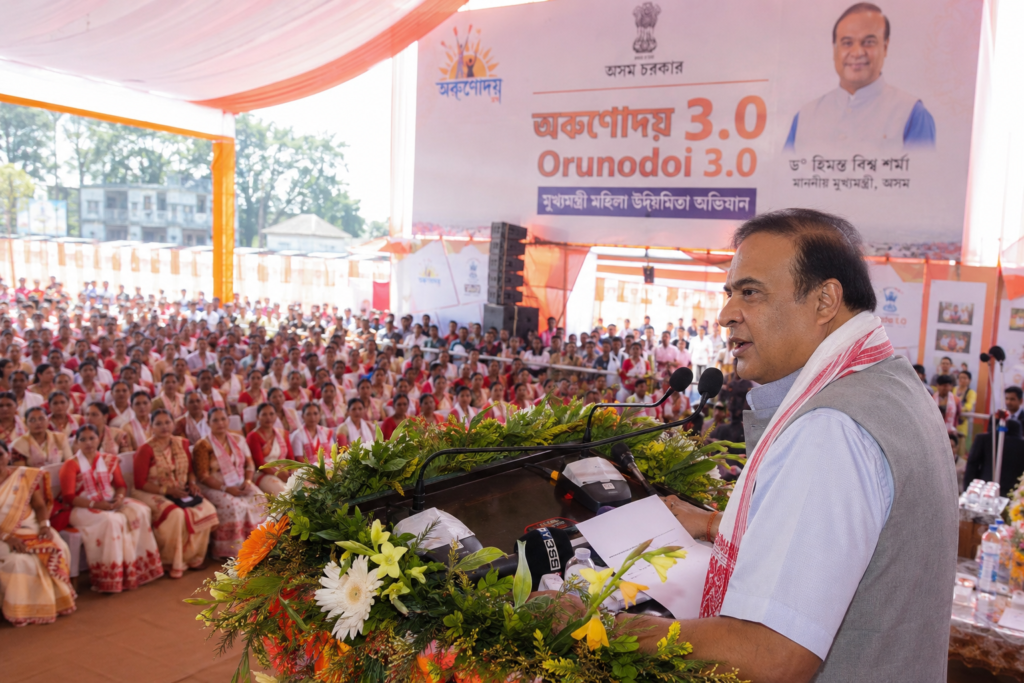
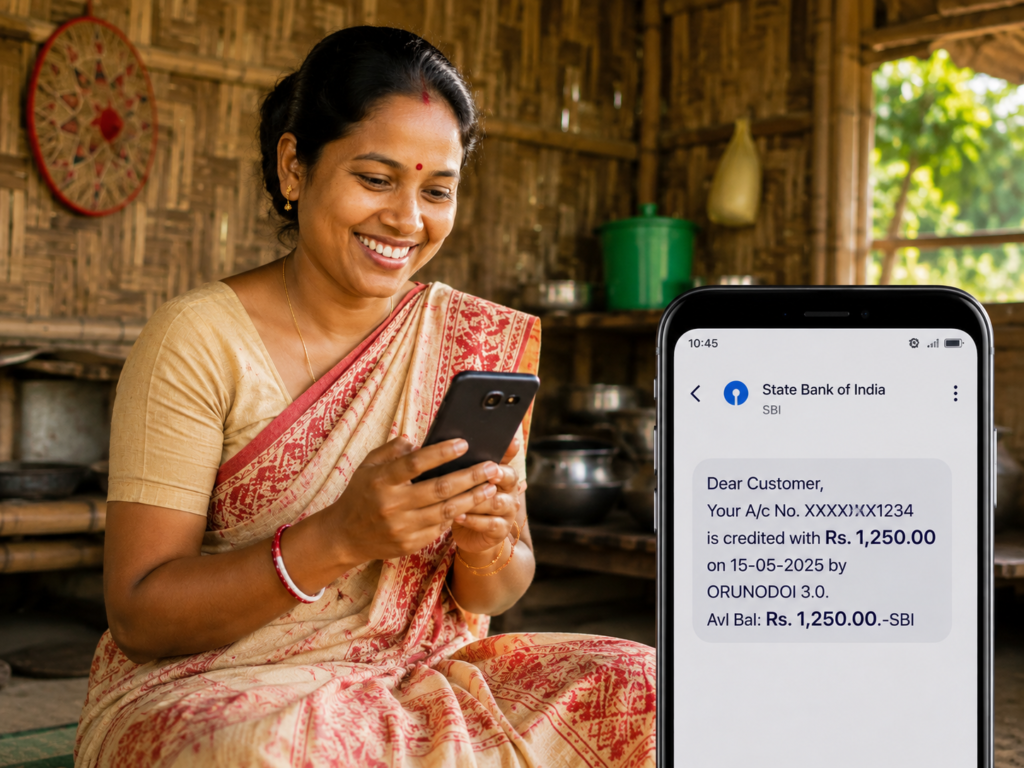
On August 1, 2026, Assam Chief Minister Dr. Himanta Biswa Sarma officially launched Orunodoi 3.0 at a grand state-level event in Guwahati. Starting from this date, over 37.1 lakh women across Assam began receiving Rs 1,250 directly into their Aadhaar-linked bank accounts through Direct Benefit Transfer (DBT).
This is not just another government scheme update. Orunodoi 3.0 marks a full structural overhaul of Assam’s most popular women-centric welfare programme with new features like the Orunodoi Sarathi system, mandatory Aadhaar seeding, flood relief enhancement, and future plans for advance loans against Orunodoi entitlements.
Whether you are an existing Orunodoi beneficiary, a family member trying to understand the new changes, or someone checking eligibility for the first time, this article covers every announcement made at today’s launch event in detail.
What Is Orunodoi? A Quick Background Before We Get Into 3.0
To fully understand what changed today, it helps to know where this scheme came from.
The Orunodoi scheme was first launched on December 1, 2020, by the Assam government under then Finance Minister (now Chief Minister) Himanta Biswa Sarma. The word “Orunodoi” in Assamese means “the rising sun” or “a new dawn” which reflects exactly what the scheme was designed to do: bring financial light into the lives of women from poor households.
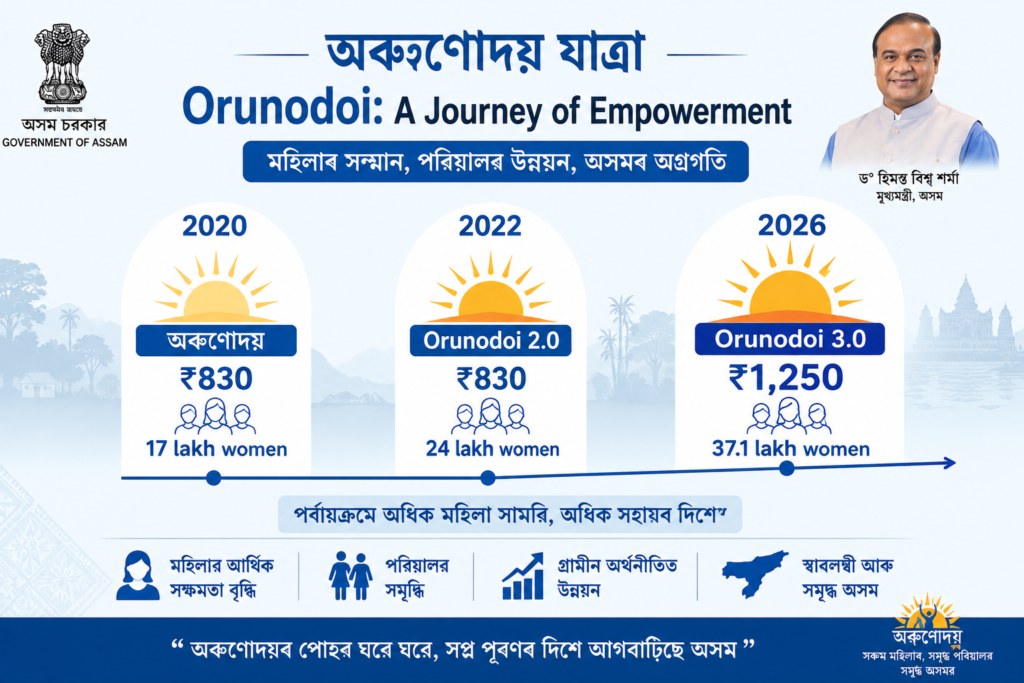
When it launched, the scheme provided Rs 830 per month to around 17 lakh women. The money went directly into the woman’s bank account every month, with no middleman, no manual process, just a clean digital transfer.
Over the years, the scheme expanded:
- 2020 (Launch): Rs 830 per month, 17 lakh beneficiaries
- 2022 (Orunodoi 2.0): Monthly amount increased, beneficiary count crossed 24 lakh
- 2024 (Orunodoi 3.0 announced): Monthly amount set at Rs 1,250, coverage expanded to 37+ lakh
- August 1, 2026 (Orunodoi 3.0 Live): Full implementation begins with Aadhaar-linked payments
Today, with an annual budget of Rs 5,604 crore, Orunodoi 3.0 stands as the largest state-run Direct Benefit Transfer programme in Assam’s history and one of the most talked-about women welfare schemes in India.
Other states including Madhya Pradesh, Chhattisgarh, Karnataka, and Maharashtra have reportedly launched similar schemes inspired by the Orunodoi model under different names.
The August 1 Launch Event: What Happened
The launch event was held simultaneously at 3,100 panchayat locations across Assam, making it one of the largest coordinated government programme launches the state has ever seen.
In Guwahati, the main event was attended by Finance Minister Jayanta Malla Baruah, three sitting MLAs including Pradyut Bordoloi (Dispur), Bijay Gupta (Central Guwahati), and Diplu Ranjan Sharma (New Guwahati), the Mayor and Deputy Mayor of Guwahati Municipal Corporation, the President of Kamrup Metro Zila Parishad, and thousands of Orunodoi beneficiaries who gathered to witness the historic moment.
CM Himanta described the scheme as a “family” rather than a government programme. He spoke at length about how the scheme has transformed household finances for millions of women, how it became a political force in the last elections, and what the next phase of Orunodoi will look like.
Here are the six major announcements from today’s event, explained in full detail.
Major Announcement 1: 37.1 Lakh Women Get Rs 1,250 From August 1
<cite index=”13-1″>Assam Chief Minister Himanta Biswa Sarma announced that Aadhaar-seeded transfers under the Orunodoi scheme would resume from August 1, with 37.1 lakh women beneficiaries receiving Rs 1,250 each.</cite>
This is a significant jump from the previous phase. In Orunodoi 2.0, around 24 lakh women were covered. With Orunodoi 3.0, over 12.5 lakh new beneficiaries have been added, bringing the total to 37.1 lakh.
The payment is transferred directly into the beneficiary’s bank account via DBT on the 10th of each month. No agent, no cash counter, no queue.
If you are already in the system and your Aadhaar is linked to your bank account, the money should reflect in your account within 1 to 3 working days from the 1st of August. If your Aadhaar is not yet linked, the government has committed to releasing pending amounts once the linking process is complete, likely in September 2026.
Major Announcement 2: Flood-Affected Women Get Rs 2,500 This Month
One of the most emotionally significant moments of today’s event was the flood relief announcement.
<cite index=”5-1″>CM Sarma announced immediate financial assistance of Rs 2,500 for beneficiaries in flood-hit districts. He said the collected funds would be used to support flood-affected families in Sivasagar, Charaideo, Jorhat, and Golaghat districts.</cite>
Women in these four districts will receive double the usual amount this month. Instead of Rs 1,250, they will get Rs 2,500 as a one-time enhanced transfer for August 2026.
But what made this announcement even more special was what CM revealed next. He said that approximately 34 lakh Orunodoi women voluntarily contributed Rs 150 each from their own entitlements to help flood victims. That is a total of around Rs 51 crore raised voluntarily by the beneficiaries themselves.
<cite index=”5-1″>Describing Orunodoi as more than just a welfare scheme, Sarma said it had become a “family” connecting millions of women across Assam.</cite>
This is a remarkable shift in how a welfare scheme functions. Rather than being a passive receiver of government funds, these 37 lakh women have become an active community. They supported each other in a crisis. That is the kind of organic social infrastructure that most government programmes never manage to build.
Major Announcement 3: Orunodoi Sarathi System in Every Constituency
This is the most operationally important new feature announced today.
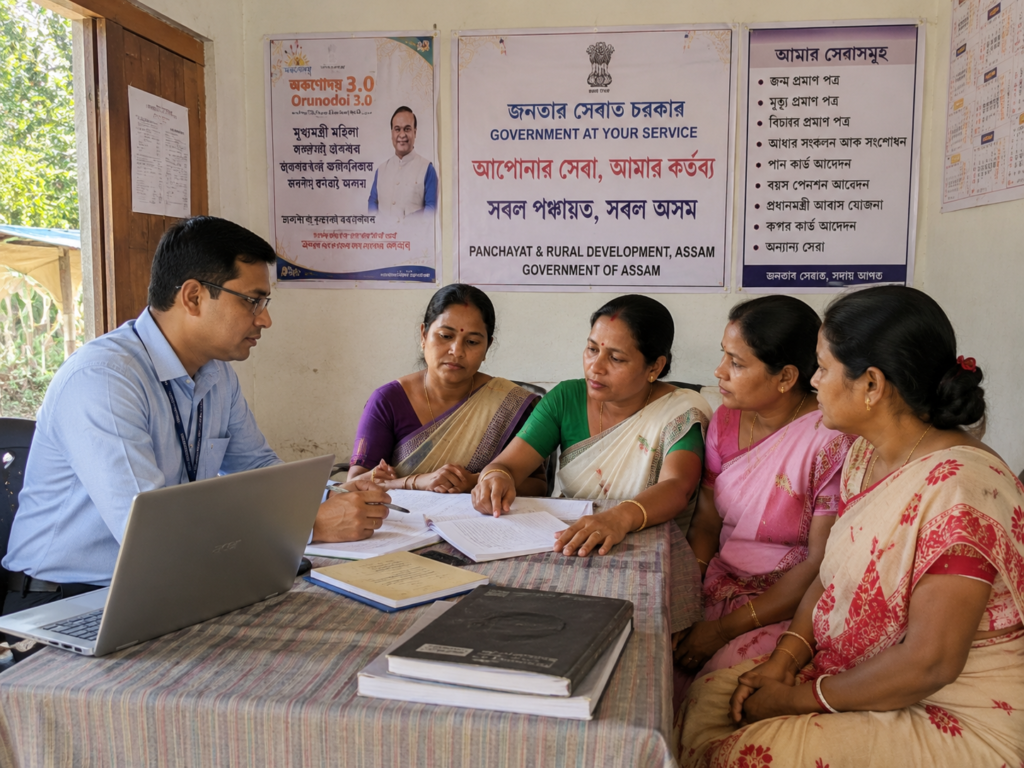
<cite index=”5-1″>To improve service delivery, the Chief Minister announced that every Assembly constituency will have a dedicated Orunodoi Sarathi to assist beneficiaries and address grievances related to the scheme. He said the Sarathis would ensure that eligible beneficiaries receive their entitlements without difficulty.</cite>
What exactly is an Orunodoi Sarathi?
A Sarathi (which means “charioteer” or “guide” in Sanskrit) is a locally appointed individual who will act as the single point of contact for all Orunodoi-related problems in a constituency.
Here is how it will work in practice:
- Each Assembly constituency in Assam will have one dedicated Sarathi
- Their name and mobile number will be publicly shared through official channels
- If a beneficiary’s payment is delayed, they call the Sarathi instead of running to district offices
- If there is an Aadhaar linking issue, bank KYC problem, or account mismatch, the Sarathi coordinates with the bank directly
- The Sarathi will also ensure that women who are eligible but not yet in the system are properly enrolled
Until now, a woman who did not receive her Orunodoi payment had no clear local point of contact. She either had to figure it out herself, call a generic helpline, or travel to the district office. That friction is now being addressed directly.
The Sarathi system essentially turns Orunodoi from a scheme into a managed service.
Major Announcement 4: Aadhaar Linking Is Now Mandatory
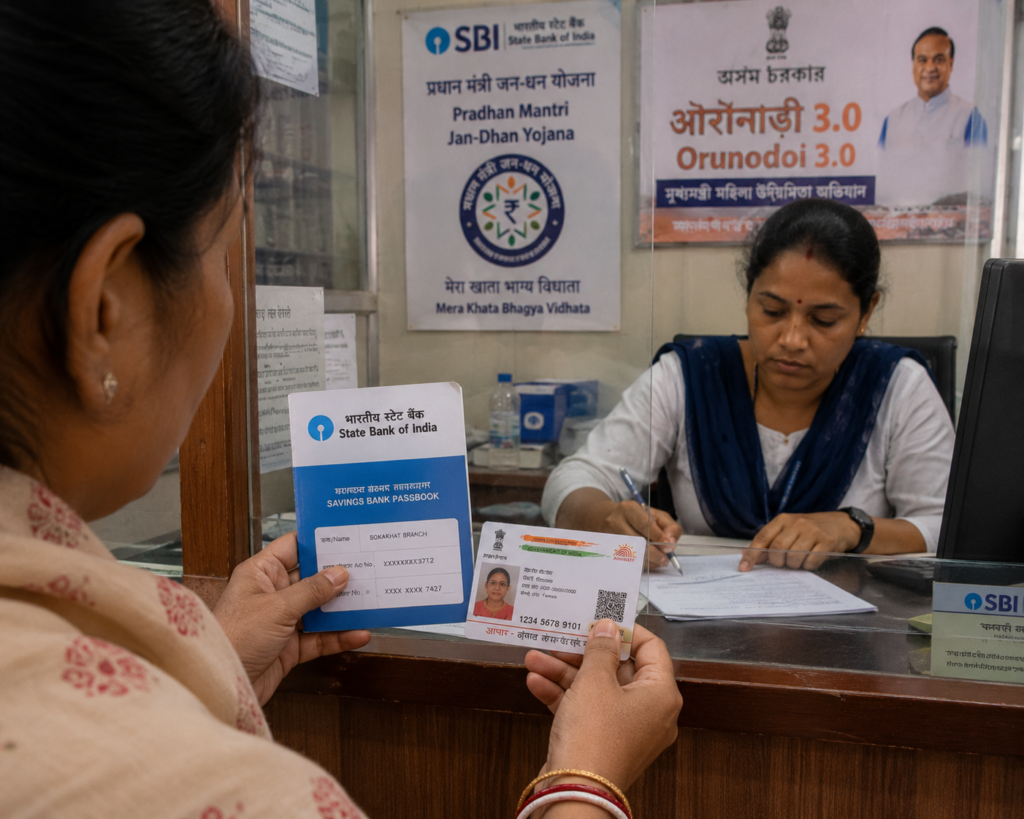
CM Himanta made this change very clear today: Aadhaar must be linked to your bank account to receive Orunodoi 3.0 payments. This is not optional.
<cite index=”16-1″>CM Sarma announced that Aadhaar-based verification has now been made mandatory for beneficiaries to ensure secure, seamless and hassle-free Direct Benefit Transfer into their bank accounts.</cite>
Why was this step necessary?
Over the years, a recurring problem had emerged. When the government transferred Orunodoi funds, some women would call and say they never received the money, but the transfer records showed the money had been sent. On investigation, it turned out that many beneficiary forms had been filled with a family member’s or another person’s bank account instead of the actual beneficiary’s. The money was going into someone else’s account, and that person was spending it.
By linking Aadhaar to the bank account, the system now verifies that:
- The name on the Orunodoi record matches the Aadhaar
- The Aadhaar matches the bank account
- Only the actual registered woman can access the funds
This creates a tamper-proof pipeline from the government to the rightful beneficiary.
What should you do if your Aadhaar is not linked?
- Visit your nearest bank branch
- Carry your Aadhaar card and bank passbook
- Fill out the Aadhaar Seeding form at the bank counter
- The bank will process it within 7 to 15 working days
- You will receive an SMS confirmation
CM has assured that women who miss the August payment due to Aadhaar issues will receive all pending amounts in September 2026 once the process is complete.
Major Announcement 5: Advance Loan Against Orunodoi Entitlement (Coming Soon)
This was perhaps the most forward-looking announcement of the day, and it positions Orunodoi 3.0 not just as a welfare transfer but as a financial access tool.
CM Himanta explained the concept clearly with an example.
A woman receives Rs 1,250 every month. In a full year, that comes to Rs 15,000. Now suppose she needs Rs 5,000 urgently for her daughter’s school admission, a medical emergency, or a festival expense. Today, she has no option except to borrow from a moneylender or ask a relative.
Under the new system being planned:
Option A: Advance from Orunodoi
- The government will allow her to take her upcoming installments in advance
- She gets Rs 5,000 or Rs 8,000 upfront now
- Her monthly installments are then deducted until the advance is recovered
- No interest, no moneylender, no humiliation
Option B: Orunodoi-backed Bank Loan
- Similar to how a salaried employee takes a salary loan with EMIs deducted from salary
- The beneficiary uses her Orunodoi entitlement as collateral with the bank
- She gets a loan (say Rs 1 lakh) from the bank
- Monthly Rs 500 is deducted from her Orunodoi payment as installment
- She keeps the rest and uses the loan amount for productive purposes
This is a significant upgrade. It converts a passive monthly transfer into an asset that women can leverage for bigger financial goals. More details and a launch date for this feature are expected to be announced in the coming weeks.
Major Announcement 6: Beneficiary Count and Monthly Amount Will Keep Growing
CM made an open commitment today: Orunodoi will not stop at 37.1 lakh or Rs 1,250.
He confirmed that:
- The beneficiary count will continue to expand in future phases
- The monthly assistance amount will be gradually increased over time
- Families who are currently eligible but missed out due to technical or database issues will be included in the next cycle
He also mentioned a specific pain point that will be addressed: In many households, the ration card has one woman’s name while the Orunodoi beneficiary is a different woman in the same house. This creates duplication issues. A mother-in-law and daughter-in-law cannot both receive Orunodoi from the same household. CM said this inclusion-exclusion problem will be resolved in a structured way in the upcoming phase.
Who Is Eligible for Orunodoi 3.0?
If you are checking for the first time whether you or someone in your family qualifies, here is the complete eligibility breakdown.
Core Eligibility Requirements:
- Must be a permanent resident of Assam
- Must be a woman
- Age must be between 16 and 59 years
- Annual family income must be below Rs 2 lakh
- Must belong to an AAY (Antyodaya Anna Yojana) or NFSA ration card household
Priority Categories:
Orunodoi 3.0 gives special priority to the following groups:
- Widows
- Women with disabilities (Divyangjan)
- SC (Scheduled Caste) and ST (Scheduled Tribe) households
- BPL (Below Poverty Line) families
- Elderly women heading households
Disqualifying Factors:
You are not eligible if:
- Any family member is a government employee or pensioner
- The household pays income tax
- The family owns more than 2.5 acres of irrigated agricultural land
- The family owns a four-wheeler (car)
- The family has a member with a salary above a certain threshold
How to Check Your Name in the Orunodoi 3.0 Beneficiary List
There are three ways to verify if you are included in the Orunodoi 3.0 beneficiary list.
Method 1: Official Government Website
Visit the Assam Finance Department portal at rcm.assam.gov.in. Navigate to the Orunodoi section, select your district, block, and panchayat, and search for your name. The AAY list is publicly available and Orunodoi 3.0 is largely built on that database.
Method 2: District Commissioner Office
Visit your nearest DC office or Block Development Office and request to check your name in the AAY or Orunodoi list. Carry your Aadhaar card and ration card.
Method 3: Orunodoi Sarathi (Once Appointed)
Once the Sarathi system rolls out in your constituency, you will be able to call the local Sarathi directly to check your status, confirm payment details, or resolve any issues. The Sarathi’s contact details will be shared through official government channels and panchayat offices.
Orunodoi 3.0 vs Orunodoi 2.0: What Changed
| Parameter | Orunodoi 2.0 | Orunodoi 3.0 |
|---|---|---|
| Monthly Amount | Rs 830 to Rs 1,000 | Rs 1,250 |
| Total Beneficiaries | Around 24 lakh | 37.1 lakh |
| Payment Mode | Bank transfer | Aadhaar-linked DBT only |
| Grievance System | Centralized helpline | Local Orunodoi Sarathi per constituency |
| Flood Relief | Standard amount | Rs 2,500 (one-time for flood districts) |
| Advance Facility | Not available | Being introduced |
| Bank Loan Option | Not available | Being introduced |
| Verification | Basic | Aadhaar-biometric mandatory |
| Annual Budget | Lower | Rs 5,604 crore |
Key Figures and Facts: Orunodoi 3.0 at a Glance
- Official Launch Date: August 1, 2026
- Total Beneficiaries: 37.1 lakh women
- Monthly Transfer Amount: Rs 1,250
- Annual Programme Budget: Rs 5,604 crore
- Flood District Beneficiaries (August): Rs 2,500 (Sivasagar, Charaideo, Jorhat, Golaghat)
- New Beneficiaries Added vs 2.0: Over 12.5 lakh
- Payment Date: 10th of each month (via DBT)
- Payment Mode: Aadhaar-seeded direct bank transfer
- Grievance Channel: Orunodoi Sarathi (one per constituency)
- Helpline Number: 1800-202-6256 (10 AM to 6 PM, working days)
- Official Website: rcm.assam.gov.in
- Verification Requirement: Aadhaar must be linked to bank account
What If Your Aadhaar Is Not Linked Yet?
If your Aadhaar is not yet linked to your bank account, do not panic. But act quickly.
CM has made it clear that women who miss August’s payment because of Aadhaar linking issues will receive their pending payment in September. However, you need to complete the linking process as soon as possible to avoid further delays.
Steps to Link Aadhaar to Bank Account:
Step 1: Visit your nearest bank branch where your Orunodoi account is held.
Step 2: Carry both your Aadhaar card (original and photocopy) and your bank passbook.
Step 3: Ask the bank representative for the “Aadhaar Seeding” or “Aadhaar Linking” form.
Step 4: Fill out the form and submit it along with photocopies.
Step 5: The bank will process the linking within 7 to 15 working days.
Step 6: You will receive a confirmation SMS on your registered mobile number.
Some banks also allow Aadhaar linking via ATM or net banking. Check with your specific bank for self-service options.
The Political Significance of Orunodoi
CM Himanta spoke openly today about something that is rarely discussed in a government event setting: the political impact of this scheme.
He noted that during the recent elections, political parties that criticized or spoke against Orunodoi paid a heavy price at the ballot box. Voters, particularly women, made their preference clear.
“Those who abused Orunodoi did not get a single vote,” he said at the event. “Instead of criticizing this scheme, parties should have demanded that Orunodoi be made bigger and better. That is what the women of Assam wanted to hear.”
This is a striking statement because it reflects how deeply Orunodoi has embedded itself in Assam’s social fabric. It is no longer just a line item in the budget. For 37 lakh families, it is a dependable monthly lifeline that they will go out and vote to protect.
From a policy perspective, this also sends a signal to other states: direct cash transfers to women, when done consistently and transparently, build extraordinary political and social goodwill.
Orunodoi and the Broader Women Empowerment Story in Assam
It is worth stepping back and understanding what Orunodoi 3.0 means in the larger context of women’s economic empowerment in Assam.
When 37 lakh women each receive Rs 1,250 per month, that is Rs 463 crore flowing directly into the hands of women every single month at the grassroots level. Over a year, that is over Rs 5,500 crore circulating in local economies across Assam.
This money does not sit idle. It goes into:
- Purchasing medicines, groceries, and daily essentials
- Paying school fees for children
- Buying raw materials for small home-based businesses
- Building small savings that act as emergency cushions
<cite index=”12-1″>With a budget of Rs 5,604 crore, Orunodoi 3.0 adds over 12.5 lakh new beneficiaries compared to the previous edition, making it the largest state-run Direct Benefit Transfer initiative in Assam’s history.</cite>
The advance loan feature being planned will amplify this impact further. When women can leverage their Orunodoi entitlement to access formal bank credit, it breaks the dependency on moneylenders that has trapped generations of rural families in debt cycles.
The Orunodoi Sarathi system ensures that this empowerment is not derailed by administrative friction. Having a local, accessible human point of contact for every constituency means that no eligible woman loses her benefit because of a paperwork error or KYC delay.
Taken together, Orunodoi 3.0 is not just a welfare update. It is a comprehensive redesign of how the state government delivers financial inclusion to its most vulnerable women.
Frequently Asked Questions About Orunodoi 3.0
Q: When will I receive my Orunodoi 3.0 payment?
A: The August 2026 disbursement started on August 1, 2026. If your Aadhaar is linked to your bank account, the money will reflect within 1 to 3 working days. If your Aadhaar is not yet linked, you will receive the pending amount in September 2026 after completing the verification process.
Q: How much money do I get under Orunodoi 3.0?
A: Rs 1,250 per month. If you live in one of the four flood-affected districts (Sivasagar, Charaideo, Jorhat, Golaghat), you will receive Rs 2,500 for the month of August 2026 as a one-time flood relief enhancement.
Q: How do I check if my name is in the Orunodoi 3.0 beneficiary list?
A: Visit rcm.assam.gov.in and look for the beneficiary list section. You can also check at your DC office or Block Development Office using your Aadhaar and ration card. AAY ration card holders are automatically considered for inclusion.
Q: Can I apply for Orunodoi 3.0 online?
A: There is no separate online application portal for Orunodoi 3.0. Beneficiaries are selected based on the AAY (Antyodaya Anna Yojana) database maintained by the state government. If you believe you are eligible but not included, contact your local panchayat or Block Development Office.
Q: Who is the Orunodoi Sarathi and how do I contact them?
A: The Orunodoi Sarathi is a locally appointed person who will handle all scheme-related queries and grievances in each Assembly constituency. CM announced this system today and the Sarathis will be appointed and their contact details shared through official government channels shortly.
Q: What if my Aadhaar is not linked to my bank account?
A: Visit your bank branch immediately with your Aadhaar card and bank passbook. Fill out the Aadhaar Seeding form. The process takes 7 to 15 working days. Once done, your pending payment will be credited.
Q: Is the advance loan feature available right now?
A: Not yet. CM Himanta announced the advance loan and Orunodoi-backed bank loan concepts at today’s event as upcoming features. The official implementation date will be announced separately. We will update this page as soon as details are confirmed.
Q: What is the Orunodoi helpline number?
A: The toll-free helpline is 1800-202-6256. It is active on working days from 10 AM to 6 PM.
Q: Will the Rs 1,250 amount increase in the future?
A: CM Himanta confirmed today that the monthly assistance amount will be increased gradually over time. No specific new amount or date was announced, but the commitment was made publicly.
Q: Can my mother-in-law and I both receive Orunodoi in the same household?
A: Currently, only one woman per household receives the benefit. CM acknowledged this issue today and said it will be addressed in the next phase of the scheme.
What You Should Do Right Now
If you are an existing Orunodoi beneficiary or suspect you might be eligible, here are the immediate steps to take:
First, check whether your Aadhaar is linked to your bank account. If it is not, go to your bank branch and complete the Aadhaar Seeding process today. This is the single most important action you can take to ensure you do not miss payments.
Second, verify your name in the beneficiary list on rcm.assam.gov.in or at your local DC office if you have not done so already.
Third, once the Orunodoi Sarathi is appointed in your constituency, save their contact number. They will be your fastest and most reliable point of contact for any future issues.
Fourth, keep an eye on updates about the advance loan feature. If this rolls out as announced, it could be a major financial tool for families who need short-term emergency funds.
Fifth, if you live in a flood-affected district (Sivasagar, Charaideo, Jorhat, or Golaghat), check your account for the Rs 2,500 credit that should arrive this month.
Stay Updated With orunodoi.co.in
This article was published on orunodoi.co.in, the most dedicated resource for Orunodoi scheme updates, beneficiary information, and Assam government welfare news.
We covered today’s launch event live and compiled every major announcement from CM Himanta Biswa Sarma’s address. All key details have been verified against official news sources including Sentinel Assam, ANI, Northeast Today, and the Assam government’s Finance Department.
As new updates emerge about the Orunodoi Sarathi appointments, advance loan launch dates, and the next phase of beneficiary expansion, we will update this article with accurate information.
If you found this article helpful, share it with women in your family and community who might benefit from knowing about these changes. The more people know their rights and the process, the more effectively this scheme can reach those who truly need it.
For any questions or to stay updated, bookmark orunodoi.co.in and visit us regularly.
Published: August 1, 2026 | Source: CM Himanta Biswa Sarma’s Official Launch Event, Sentinel Assam, ANI, Northeast Today, Finance Department Assam | Category: Orunodoi Scheme, Assam Government Schemes